Wednesday, May 13, 2015

More on Find in Germany VS France

I am now used to the differences in finds between France and my part of Germany (Berlin and surrounding areas)

In France, lace bits abound. They were everywhere and it was great fun to buy them. That same lace bit in Berlin is costs 10 times more! Quite the culture shock.

So let's talk about the differences of what I find here in Germany vs France.

I have already mentioned lace bits. Gone are these days where I have mounds of it in the sewing room.
It just does not exist here in quantity and when found is way over the top expensive.

What is not in most picture from France are buttons. Buttons when I found them
were not something I would buy. I did buy a card of buttons here:
I have not used them yet. I need that just right project for them. 

The norm has been a lack of the type of buttons I would use for my projects. I would like Mother or Pearl and vintage glass buttons or for that matter any sort of interesting buttons. I quit looking in France since when I did find them it they were priced like the lace bits are here.

So what does one find here? Interestingly embroidered tablecloths are everywhere. So abundant are they that I can be picky about what I buy. Here is a nice selection of some of them now in my collection for a future project:
I have already mentioned buttons:
These mostly fall in the interesting category.  But there are some real jems hidden in that stack. A few of the buttons have been used already. 

Here are some Mother of Pearl buttons I was able to use on the crazy patch block I just finished:

Here from is another block:
The above block is a work in progress right now

Other types of finds are pillowcases and tablecloths. all of the embroidered ones in the earlier picture are either table clothes or pillow cases. One can also find white on white embroidery as well. Here is a set I found at a flea market:
Other finds were ready made somewhat vintage embroidery motifs. What a time saver. They will keep me from embroidering them myself or having to dye modern ones to match my latest project.
Oh and since I am talking about crazy patch blocks. I finished the first one to my project. Only 15 to go!
Here are a couple of closeups:

Lastly, thank you for your comments about my last blog on my remake of the By Popular Demand shirt. Now all I need is some warm weather to wear it!




Thursday, May 7, 2015

By Popular Demand, with a slight modification

 Remember this picture? It is from the blog entry titled "The Last Hurrah"
I found the medium weight linen in Berlin and the lace came from a find in Brittany. I have wanting to make something out of it and I had a Pinterest inspiration and here it is:
The top was made by an Etsy company called Linen Clothing by bonnie harris 
This one has long since sold, and for good reason.

Although pretty, I know how a tank top like that would look on me. I need a little wider on the shoulders. I am also limited for lace bits here as most of my collection is in storage until August. But I do have my Brittany find with me.

Enter in a Louise Cutting pattern called "By Popular Demand".
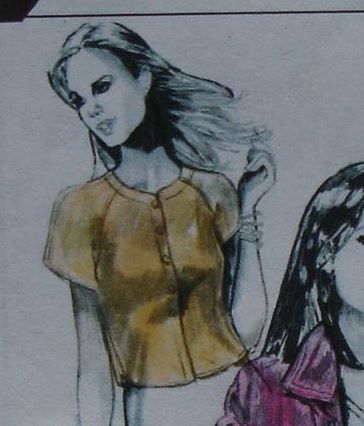
I really like how well they are drafted so I know I can play with them and still have something that will go together and fit well. In this pattern, I love the yellow top in the background. Someday I am going to make it as is, really...

Here is my rendition of the top.
A little bit different you say? You would be correct.  It is a size small. 

Changes made:
The pattern was lengthened by 6 inches
The bottom hem curve was eliminated
The center front neck edge was changed
Front opening was eliminated
From the center front line, 1-1/8 inches were added for the pleat. 

I was not sure I needed to do the pleat, but I did not want a form fit and I wanted movement and I needed some sort of interest for the front. 

The vintage lace is  11-1/4 inches wide. This is important: The lace has got to hit on the widest part of the hip, a little lower below the hip or right under the bust. Anywhere between those two places and you look like you are stuffed. It is not an attractive look. 

I experimented with the lace and where it should fall and was just amazed at how unattractive it could look if it was any higher than you see it in the picture. Note the Pinterest picture and were the lace begins and you will see that same hip placement.

The bottom of the lace is longer than the hem. This was so that the bottom of the garment has curves. Due to the weight of the lace, it wanted to sag. So that it does not sag, it is tacked into place where the larger filled in designs are and where ever there was a cross section on the lace. A bit of work, but worth it

I tried different things for the front of the top trying to get the look of the inspirational piece, but nothing worked for me except for the pleat and some wonderful vintage glass buttons. I found  5 of them at a flea market a couple weeks ago.
The buttons are heavy and without the pleat and the extra fabric to hold onto it may have caused the front center to sag.

Oh and one last change, since I changed the front opening I needed a way to get the top over my head. A placket was put in  on the back. I was also able to use that 5th button.
I still love that inspirational piece and I bet I make another rendition of it again once everything comes out of storage patterns included. I have some great lace pieces I could use, but in the mean time I have a new top which pictures are not doing justice and looks really good on me. Just in time for summer!

Tuesday, April 28, 2015

Another Mystery Solved

Dorset buttons (given that name due to the area that produced many of them) are a thread button wrapped around a bone or plastic loop that was mostly used, as I have observed from finding vintage clothing items in France, on woman's undergarments. Of course it was used on men's clothing as well but at least for woman, it would seem that thread buttons were soft and comfortable against the skin especially under tight corsets or while sleeping.
Threads used to make these buttons were a cotton or linen thread, depending on the ultimate use of the button. Normally they are are approximately 1/2" to 3/4" (1 to 1 1/2 cm) in diameter.

When first moving to Berlin I was surprised to find Dorset buttons in abundance at the flea markets and second hand stores. Dating them ranged from the 1950s and older. Nowhere did I see vintage or modern wear that would use this type of button. So why were they there? Why so any of them?

Now for a little more observation. In France and I might add in Southern Germany when one buys vintage and not so vintage pillow cases, on them are linen or cotton covered buttons like these:
One can even buy these buttons in sewing stores and department store today as they are used to hold the pillow cases or the duvets closed. 

So back to the Dorset button mystery. Why so many? I think I have the answer. Again second hand store and flea market finds. More than once I have found this:
A Dorset button used on a pillowcase. I do not recall seeing this in France. I have an embarrassingly large collection of bedding from France as I love raised work embroidery and linen sheets. Normally in France it is a linen covered button or, more commonly, mother of pearl buttons that holds the opening to the pillowcase closed. Using Dorset is new to me. Again, by observation I have now seen this many times on the closures to vintage bedding in Germany, or at least this area of Germany.

What you are looking at with the Dorset button and hand made button hole is a well used baby pillowcase I found at a bargain price.  I bought it stained and inspecting it, it is not particularly well made. I bought it because of the two strips of insertion:
 It also came with two Dorset buttons which hold the pillowcase closed. This particular insertion is very common and machine made. This particular pattern was found everywhere in Europe and the United States and probably beyond. I have plans for it for my crazy patch quilt.

Thursday, April 23, 2015

Still, No Signs of an East German Textile Success.

At a second hand store I picked up a bag of filet/crochet yarn. Two different former East German companies were represented in the bag.

The first yarn this time takes us to the small river town  of Premnitz located in Havelland (district), in Brandenburg Germany. Premnitz is situated on the Havel river about 75 km west of Berlin.

Back in 1915 the chemical industry moved to this town. To be specific the company that moved to town was the precursor to a factory by the name of VEB chemical fiber factory "Friedrich Engels". 

In 1949, now part of the DDR this company like so many others was expropriated and made a state-owned enterprise. In 1960, this factory got its name VEB chemical fiber factory "Friedrich Engels". 
I am no longer surprised to find pictures you can click on to see what is left to the new plant, the old one was torn down year before. You can also read more about the history if you would like. Translation might be necessary if your German is not so good, 

In the same bag was yarn from VEB alwo Altenburger wollspinnerei.

The building of the Alwo Altenberger wollspinnerei was built in 1871 in Meerane Germany. Meerane is located in the Zwickau District of Saxony Germany pretty close to what is now the Czech border. In the 1920's this town was very prosperous. Due to what was manufactured, the factory was not updated when it became part of the DDR (I guess actually I should be calling it the GDR, but everything says DDR on the labels). During the time the factory was state owned by the GDR, the factory employed nearly 900 employees. In 1993, the company existed as the Neue Altenburger Wollspinnerei. Unfortunately, the company did not make it. Today the building is used as the largest nightclub in eastern Thuringia. 

You can see pictures of the factory ruin here.
All yarns in the bag are "silk" Rayon and are the thickness of #5 pearl cotton. I plan to play with these later. Rayon dyes so nicely. 

What strikes me as I am finding these things at flea markets and second hand stores is the shear number of jobs that were lost when the wall fell. Although we tend to think, in the west, that the free economic model is the best model, there was a good side to Communism as well. Jobs and worker's child care quickly come to mind. Jobs like these, the ones that make thread or yarn now with a few exceptions, follow poverty.Where ever they can be done the cheapest is where they are manufactured.

To change topics off of unemployment, I am working on a crazy patch quilt so I might add some of this yarn as I go. For now, here is a little of what I have been working on:
The pearls were part of a large necklace with pearls of many sizes that I picked up at a second hand store. Since the necklace was broken it was easy to re-purpose some of them. 

The search continues for buttons, beads and whatevers to put on my quilt as well. The latest find was around a nice lot of mother of pearl buttons, a few of them carved, and some assorted other buttons were tossed in for good measure. A few were glass or metal. The vintage glass red one in the center won't work for this project but it is so pretty. I get so excited when I find vintage glass or carved mother of pearl as I am wrist deep in other peoples old buttons.
I have also found some beads of all types as well. Mostly in hobby shops, but the prices are reasonable so I have collecting.

This week I am joining My Salvaged Treasure Vintage Inspiration party.


Tuesday, April 14, 2015

Deutsche Moden-Zeitung, Verlag Otto Beyer

I found one! Funny how when you know what to look for you find it. On a bike ride along what once was part of the Berlin Wall, there was a flea market. Just a quick walk through produced this magazine:
It is in fragile condition, but it is in its entirety meaning, the pattern is included. 

First some history before we take a small tour and I point out somethings that are very different from how we do things today.

First note that unlike the black and white DDR copy, this one is Verlag Otto Beyer, Leipzig-Berlin This woman's magazine, Deutsche Moden-Zeitung was published between the years 1886 to 1944 The circulation in 1939 was 110,195 copies.  This one is issue number 3 and it says that the magazine in it's 41st year of publication. The year does not match the 1886 start date, but there were mergers to this magazine which might account for this. The year is 1931/32 and the cost for the issue was 50 pfennigs. Using United States inflation figures makes this a $7.30 magazine in today's dollars. Not a bad price for all of those patterns.

Just like the French Magazines I have collected, this one is done in the same manner. the difference between the two appears to be the number of patterns included. Just about every drawing for a pattern you see is included. 

My favorite pattern is this one:
The one to the left to be more specific, although the one on the right is just as nice.

Now here is where the French magazine differs from the German one. Here is the pattern sheet. (Shown below is a different dress, the one I like is on the inside and I do not want to unfold the pattern sheet more than I have to.)

On the left column is the drawing for the dress you might want to sew and all of the parts you will need to trace off are listed. I still have to work out the sizes. It is not clear like the French magazine, but I will figure it out. Fist I have to stumble over the old German. It makes reading it a bit hard for me.
Now for the pattern page itself:
Does your head hurt yet? I know mine does. Far more busy than the French ones. But,this makes sense as there are so many more patterns included in the issue.

Now what about the rest of this issue? Well, there was an article that caught my eye that I thought was interesting. After WWI, Germany went through a period (June 1921 to January 1924) of hyper inflation. They had already suffered the loss of WWI and were now paying large monetary costs for war reparations. In reading about it, it makes the United States Great depression sound like a cake walk. I can imagine that people became very frugal during those times and that thought process was still with them in everyday life in the 1930s. So what is a thrifty sewer to do? In today's world, you can see all of the ideas on Pinterest and there are books out about refashioning out right now as well as lots of blog ideas. Here are some from The Renegade Seamstress. Just page through, there are all types of ideas.

Now lets look at 1931 post-WWI Germany and see what the  thrifty sewer did. She raided her husband, brother or Father's closet! You need a new ski jacket? No problem and the upper right in picture pattern is included, you just need to make a small modification of a pattern in this issue. They even included what type of coat you are looking for to make this jacket.
Lastly, before we leave this issue, if you need to order any of Verlag Otto Beyer's books, here is the listing 
Left in the picture above is the post card for ordering the magazine. I have always wanted to fill on in and see what happens. Oh, and delivery to the house will cost you an extra 5 pfennigs.
Here is the second page of publications you can order:
When I bought this magazine I also got 2 others. The vendor had 3 of them and gave me a good price for all of them together so I bought them. Once I investigate when they were published  you will get to see those too.

I have linked up with My Salvaged Treasures

Friday, April 10, 2015

Verlag Otto Beyer and a little Crazy Patch

In 1890 Otto Beyer started his publishing house in Leipzig Germany under the name Verlag Otto Beyer. It appears that Otto Beyer published numerous magazines for every thing from hobbies, cooking family, leisure and sewing. At its height in publishing after some buyouts and mergers all magazines combined publishing circulation was around 768,500 a year.

On June 30th 1946, the Verlag Otto Beyer was expropriated (verb, past tense, to take away from its owner for public use or benefit) and placed under the administration of the city of Leipzig. The publishing for woman's interests was established on July 1st, 1946.

Fast forward to the end of the DDR and it appears some or all parts were bought by Burda Media Group. Google searches make it hard to follow what happened to this publication but suffice it to say that in its DDR form, it no longer exists.

Now the reason I did the Google search was that I found a some interesting vintage DDR magazine, pamphlets really,  in a second hand store.
The publication is a two-sided cover sheet and a fold out pattern inside. Most of the designs are utilitarian in nature and the publications are black and white.  I like to collect these since every once in a while I find something made from a pattern and it is fun to do a comparison to the pattern. Since patterns appear to have been limited in the DDR, it means I might find actual things made from these patterns. Of course the designs are not very original, but I am on the hunt now to see what I find.  In my Google search it was also nice to read about the other publications prior to 1946 so I can keep an eye out for them as well since German publications are new to me.

Now for sewing. I started a new crazy patch quilt, well bed runner actually. Most of my stuff is in storage right now, but some I brought here. I have been on the hunt for fun buttons and other things to put on the blocks with some success. In a button store here in Berlin (bummer, not second hand store) I found these:
Mother of pearl buttons, how pretty! The ruler shown is in inches but the button comes in two sizes, the other smaller than the one shown. I am not sure where they will go on the quilt, but they are going somewhere!

In my stash I have here in Berlin are things that came from France, I have some motifs I was hoping to use. This one was the first that jumped out of the stash onto one of the blocks.
Here it is in its new home on one of the crazy parch blocks:
A friend in the United States (Hi Mary Ellen!) gave me what appears to be a man's handkerchief with a beautiful initial "J" embroidered in blue. It could be a woman's handkerchief, but it is really plain except for the rectangle of embroidery and the handkerchief itself is rather masculine looking. 

It was pure carnage, the poor thing did not stand a chance when faced with sharp scissors:
 Here is what is left on one of the blocks:
The tatting you see on the upper right is modern and Chinese and the embroidery is a work in process.

Thursday, March 26, 2015

Side Panel Smocked Dress, a Gail Doane class

As you know from the last post, I recently had the privilege of taking a class in the United States from Gail Doane. A week of good food, great friends and fun sewing. This year I will be finishing all three projects.

Project #2 is Gail Doane's Side Panel Smocked Dress.

This project is not for the faint hearted. The smocking in this project needs be to completed before the Double Scallop Trim A-line Dress can be constructed meaning it was, at the time (and really still is), beyond my skill set. One of the other participants, Lisa, volunteered to smock mine when the class was announced. At the time I was moving from France to Germany and everything was in upheaval. I of course said YES...please! Oh I am so glad I did.

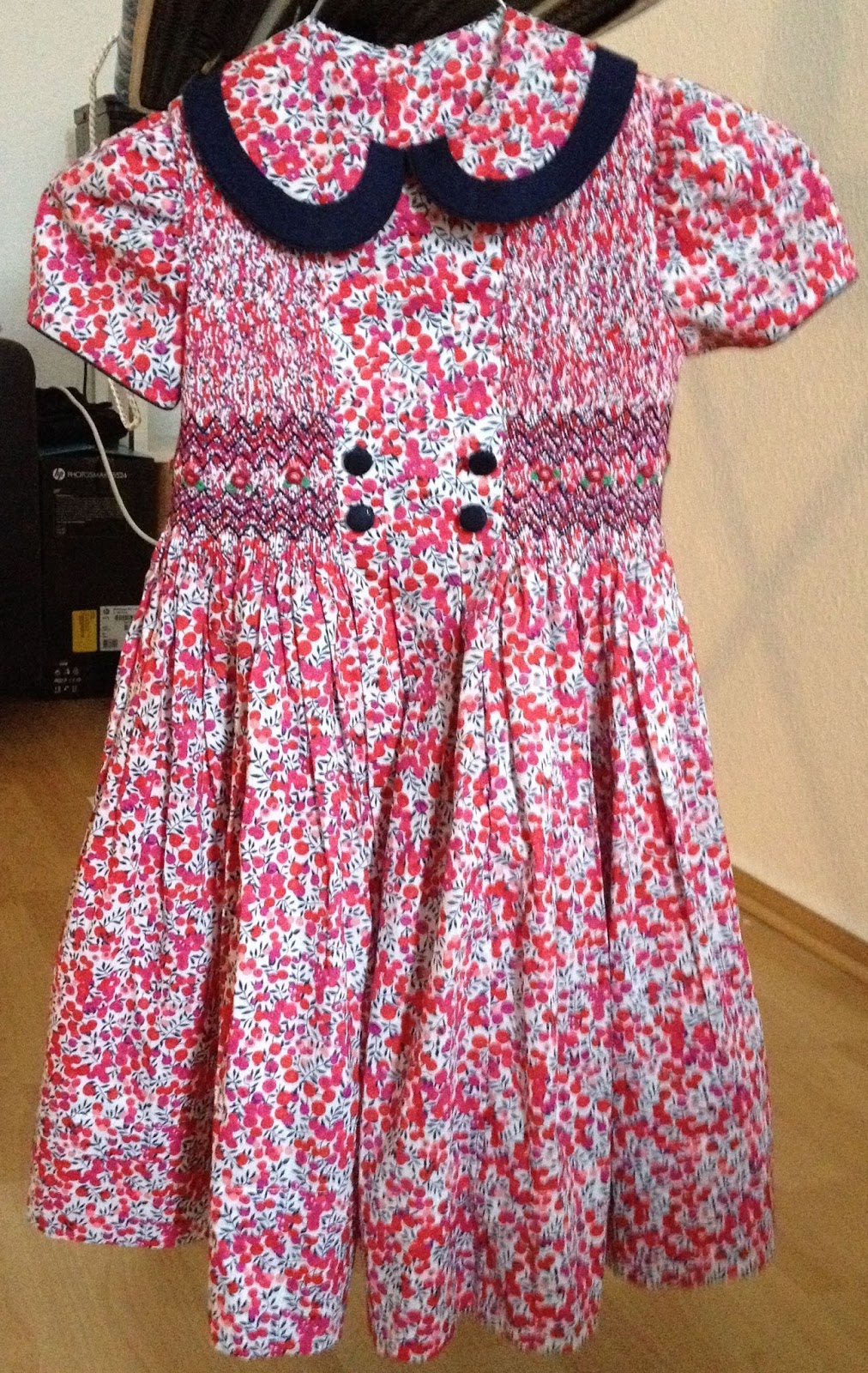
Here is completed project #2. The front: 


And the back:


Here is a close up of Lisa's wonderful smocking. I embroidered the little bullion roses.
My dress is in a different color variation than the one one on Gail's blog. You can see hers at Lulu & Annie. As you page down past the dress you will see that there is a matching coat in wool that goes with it. It is in a partial stage of completion and is next on the list to be completed. This is a generous size 4 so hopefully it will fit Grace next year.

If you take this class, heads up that you not start the smocking the night before. It takes a good while to complete as there are rows and rows of back smocking you do not see. To sew this outfit you really need to have all the smocking done to make this dress in class. 

YOU HAVE BEEN WARNED.

Once in class and once I realized just how much work the smocking had been, truly I had no idea, a gift was in order. There is a variation of the Paisley Bird jacket and Matching Dress from Gail. (she has an Etsy shop you can buy the kit for the one on the blog) Not shown in that post is a variation Gail made, shown below made from vintage mother of pearl buttons from Gail's stash.  
How cute is that???? 

Since coming back to Germany I have been wrist deep in other peoples old buttons searching for the right buttons to make this variation. The search has been fruitful. The hardest part was finding the heart shaped buttons. Gail's are Mother of Pearl. I can't find that, as a matter of a fact large heart shaped buttons of any sort in white are really hard to come by. I did find them in a plastic. I bought all 12 of them. 
I think they are a pretty good match with the mother of pearl mixture. So here is my gift to Lisa. Hopefully she makes the jacket. I have a set for myself, just in case I want to make the jacket and two other sets that go out in the post soon to one of the other women from the class. Several others want buttons too so the search for large white shaped buttons continues as does the search for vintage mother of pearl buttons.