Friday, July 26, 2013

Blue Willis

Years ago I bought a pair of brown corduroy trousers at the Westin at Hilton Head island. 

The manufacturer was a company called Blue Willis. It is one of those brands you find a specialty stores and I must say, the store at the Westin was one of those.

From the first day, I love them. I wore them and wore them and wore them out. Last year they were too threadbare to wear any longer. I mourned the loss and thought about remaking them, a la Kenneth D. King's method on Craftsy.com,  but when I brought up the subject, it was hinted strongly that they had not been the most flattering fit on me. Most likely due to the loss of stretch in the fabric. That said, it was decided that there would be no remake for them. Just darn and I have the perfect fabric! Oh well.

I couldn't just throw them away. Too much sentiment.  On the last trip from the States, I brought a pattern back with me from my childhood. A Simplicity pattern I had bought as a child. I made the red dog, without the protruding nose out of red flannel. It was stuffed with small cut up foam pieces. I remember it smelled good. 

The original pattern is long gone, but after years searching, I found it on Etsy. To test out the pattern, I first made it for my nephew. It is constructed using fleece and is stuffed with small cut up foam pieces. Like the original it has no protruding nose. When I made it I figured out why I had left if off the first time. The face of the dog is too long so when the nose is added, the nose looked out of place for the animal.

I wanted one for myself and now I had the perfect fabric. Scissors were taken to the trousers, cutting around the well worn areas. Where possible the grain of the fabric was used and some of the pieces were contrasted to give the dog interest. Interestingly  the corduroy had no nap So there was no problem cutting in either direction.The face was shortened by 1/2"  right above the nose dart and the nose was made smaller to fit the face. Lastly the label from the Trousers was unpicked and sewn onto the rear area of the dog. 

Blue as his name will be has blue eyes, The fabric used for his eyes is the wrong side of the fabric. If you look close at the picture you can see the trousers had a slight blue hue due to the back side. I do not have cut up pieces of foam here in France, but I did have a much hated memory foam pillow that was about to go to the equivalent of Good-will. Instead of being a solid piece of memory foam, the pillow was stuffed with cut up pieces of memory foam. As a bed pillow, was is not terrific, but as stuffing for the dog it would be great.

It is time to present Blue:

He sits up nicely


And he lays down well too.


The memory foam make a fantastic filler adding good weight and malleability for the dog.

Wednesday, July 24, 2013

Les coiffes catalanes part two, the completion

Remember this?

With the top completed of les coiffes catalanes, it needed embellishment and, well sort of quilted. The word quilting is used loosely since it is more like tacking and stab stitching. The piece is thick and comprises of many layers. Backing, stabilizer, a thick fabric cotton fusible, batting and then the top. The extra stabilizer is there since it will be a wall hanging and I want it to lay flat against the wall.

If one were to just use a backing, batting and then the top, this could happen. As you can see, it has happened to things I have made in the past. I hate that!

It is not pretty and several attempts to get this wall hanging to lay flat have failed. It is near a window and when the window is open air gets up behind and does this. No amount of weight on the bottom will help fix it. I have tried. Now I just smooth it out before company comes.

But enough of failures from earlier days, Onward to this new project.

The backing fabric is akin to Vichy but it is not. It is a local fabric which is used mostly in Alsace, but quite a bit here in the Lorraine region of France. It is a thicker woven with dyed threads as opposed to a dyed printed fabric.
Now for embellishing and completing my piece. As usual I have an assortment of things I can use. I have buttons, beads, trinkets and a variety of threads. 

I love taking this type of photo. All of the pretty things all in one place. The grey buttons on the card a bakelite. I still have not found the perfect project for them
I started with the beads. Recently Tess, a woman on one of my newsgroups, posted a picture of a mantilla that she had made. The lace is similar to one of the laces I used and she told me that the lace will tell you where to put the beads.  Here is her Mantilla:
 If you look closely you can see the seed beads and the pearls she used. Just Beautiful!
Taking her idea, I used little crystal seed beads and placed them where similar lace told me they needed to go. Hmm, not bad!


I have a magazine, Mon Ouvrage, from June 1952. On one of the last pages there is a pictorial article on embellishing little girls dresses and collars with buttons and embroidery. Here is the one of the ideas from the magazine:

Here it is on my piece.


I modified the idea just a little.

My buttons had four holes not two. I also had a long and narrow piece to fill. The thread is vintage silk I had in my stash.


Continuing around the wall hanging, Pearls were added.

My favorite second hand store had a pack of these vintage beauties. Part of the top design, a pivoted corners of lace was used. It was nice to be able to leave those pivot corners intact.


The pivots made a nice corner for some of the lace pieces and worked very nicely on the corners of some of the pictures. Best of all, the lace designed had flowers which cried out for the use of some of those pearls.
Continuing around the wall hanging, on one of the bottom open areas, bugle beads, buttons, pearls and silk ribbon worked well to add some interest.


There are a couple of open spaces left. they will either stay that way or maybe someday I will add to it. Right now I like it just the way it is.

Finally, it was bound using vintage lace that reminds me of footballs (American Football) It was sewn over the binding. The back has top and bottom hanging capability and it is a nice weight so hopefully it will hold itself agains the wall.

Here is the final result:

It's a keeper! 

Sunday, June 23, 2013

4th of July Embroidery

Every Christmas my family draws names for gift giving. The family is large and it is work to find gifts for everyone. Instead we exchange names. Stress is greatly reduced having only to buy for one person.

This last year I was the recipient of one of my sister's names. On her list for a gift was a shirt for the United State's 4th of July holiday. She collects holiday shirts and sweaters. One of the hardest to find is one for the 4th of July. Yes I know it is almost July,(so I am not late right?) but there is no way to have the time to do this from the time I get the name. I had to search for the embroidery design I wanted to use and then find the shirt that would work.
 
Early in the year I found the perfect shirt. It was a red tie-dye in rows of red and white. The problem was that it was Armani and the cost for a simple tee shirt was around $100 US.

Ahhh, No.

I found a knockoff in blue and white, really cute, but it was not her size. I emailed and asked...bummer!
About a week ago I found a blue and white shirt that should be her size at one of my favorite stores in Germany. The store is Globus. Think of it as a super Walmart, only larger and two stories. This store is so large that if you forget something, you might not go back to get it because the walk is too long. Last week I was trying on shirts. Tee shirts are now in the stores and the selection was good, not to mention on sale. Globus has good prices so the price was right. I found a blue and white striped on with a good fit.

Now for the design...I love the designs at Embroidery Library.  Most of the time I find just what I need, like the football turkeys I used for another gift for the same sister.  
 
I did a search and found America the Beautiful in  a really fun design format. I also found fire crackers. Laying the designs out and figuring out what to do with them was the hardest part.
 
I decided to do the name of the  design on the back and I put 4 fire crackers across the bottom.
 
On the front I put all of the other designs. I found myself singing the song as I went along each time making sure I put the next one in the correct spot.
 
Adding a couple more fire crackers to the sleeves and it is done and cute if I say so myself.
 
For the first time ever in all the years I have embroidered on items I was able to repair a bad spot.  Usually it is in a bad spot and I just have to start again. The phone rang while it was doing the first design. O Beautiful for Spacious Skies". I never answer the home phone since someone is always trying to sell me something clearly in French. But I did since I was expecting a call. While gone, the machine ate the shirt. Put a hole in it. See the star next to  "O"? It is there to cover up the eaten portion of the shirt.

Tuesday, June 11, 2013

La trousse

A trousse is a sort of kit or bag that holds groups of things. As kids we had a pencil bag (La trousse scolaire), later we had a bag for our toiletries (La trousse de toilette) and in later years we might have a bag for our medicines or a first aid kit (La trousse à pharmacie).

In sewing we could have a sewing kit (La trousse au coudre).

A couple weeks ago I was given a pattern for a sewing kit and was asked embellish it any way I wanted to. The pattern was simple. It was the embellishment that would make the bag.

The pattern was a prolate spheroid.

Hmmm, interesting but what does that mean? Well it means that its axis of symmetry is longer than its other axes. Not to be mistaken with an M&M chocolate candy, which is an oblate spheroid. Its axis of symmetry is shorter than its other axes, and definitely do not mistake it with an ellipsoid since that one is formed by rotating an ellipse around one of its two axes. The equation for this projection onto the x/y plane of an ellipse of revolution is (x/a)^2 +(x/b)^2 = 1. where 'a' and 'b' are the semi-major and semi-minor axes, respectively. Also it does not have pointy ends.  I remember this from somewhere in math background, but it is not what the pattern was.

No the pattern was definitely a prolate spheroid. click here to see the complex math that goes with it. In the meantime, I will just tell you it looked like a football.
 
American football not European football, otherwise known as soccer. There of course we are talking about a round ball. But I digress!

So you start with 3 pieces of Timtex, that would be Gifitex for us in France and you cut out 3 footballs. Size would be the size of the bag you want to make. My pattern was 4.25 (y axis) by 8.25 (x axis) inches. I thought it made a bag that was larger than I would want, but that was the size I was given to work with. You cover one side, cutting out the fabric piece about 1/2" larger than the Timtex. You baste it down through the Timtex.
 
To finish the football, you sew on a lining fabric. I cut out a slightly smaller piece of stabilizer and then fused it to the wrong side of the lining. Last step was to iron and glue the seam allowance down. That made it easy to sew the lining into place after you finish the front design that is.

Now what do I do with it. I needed a design. Finally it came to me, Sewing owls. Ya I know we think about sewing owls all the time don't we? I suppose we think about them as much as we do oblate spheroids. Yum, Chocolate!
 
Back to the owls. For the last week anytime I was in the car I was sewing owls. I needed 2 of them and I needed a needle and, well, they needed to be sewing something. Here is what I came up with for the front:
 
The small spool of thread is one of those wooden spools you can buy at craft stores. I drilled a hole in the center horizontal to the hole already there and then wound some thread on it and glued the thread in place. It was then sewn on like a regular button through the drilled hole.
 
Here is the back:
 
The fabric is Nu-Suede. I bought a pack of 18 cuts several years ago at Nancy's Notions. The lining is hand dyed silk.
 
Once I had the lining sewn on after I finished the owls, I had to sew the thing together. There is an elastic loop in the center that hooks around the spool of thread to keep it shut. Only the bottom is sewn together. Due to its shape, it closes itself.
 
I like the way it turned out.

Tuesday, May 28, 2013

Paris Box Vintage Lace Bag

It all started with a pile of dry-rotted lace left over from the making of the  "Les Coiffes Catalanes".

Even dry-rotted, the pieces were too pretty to throw out, which was OK since I had a project in mind for them and truth be told, an inspiration I saw in a window many months ago in Metz France. 

The inspiration was an expensive lacquered box with vintage looking women decoupaged all over the lid. I immediately saw something else. Not long after, I saw a Burta magazine article, at least I thought it was from Burta, on making a wood box purse. I can't find the issue, if I even have it, to save my life, but I remember some of the basics of what was done in the article.

The idea sat in my mind for quite a while. Funny how things came together once I had the dry rotted lace. I could not in good conscience take a perfectly good piece of vintage lace and apply paint and glue to it. Having dry rot gave me the permission I needed to play.


One has to be careful when applying paint to vintage lace. One could come up with something like this. 

I saw this at a second hand store and had to take a picture. The machine is real and vintage. The manikin, with bright red painted lips, is on the side board of the machine's table holding a small candelabra. A tea set sits in front with a long table topper, under it draping the manikin for "modesty". 

The whole piece is painted white. I had to take a close-up look. This was once, most likely, likely once part of a display in a store that sold haberdashery somewhere near by in France. I found it rather ghoulish and like viewing a train wreck, I ended up inspecting it for quite a while wondering who made it and what it looked like in the shop it once graced. 

Knowing I wanted to make this project, I was able to collect some items on the last trip back stateside. Between JoAnn's, Hobby Lobby, Michaels and stores here in Europe I found items I thought would work well for use on my box purse. I really like the pieces by Jim Holtz. they are well made and fun to use.

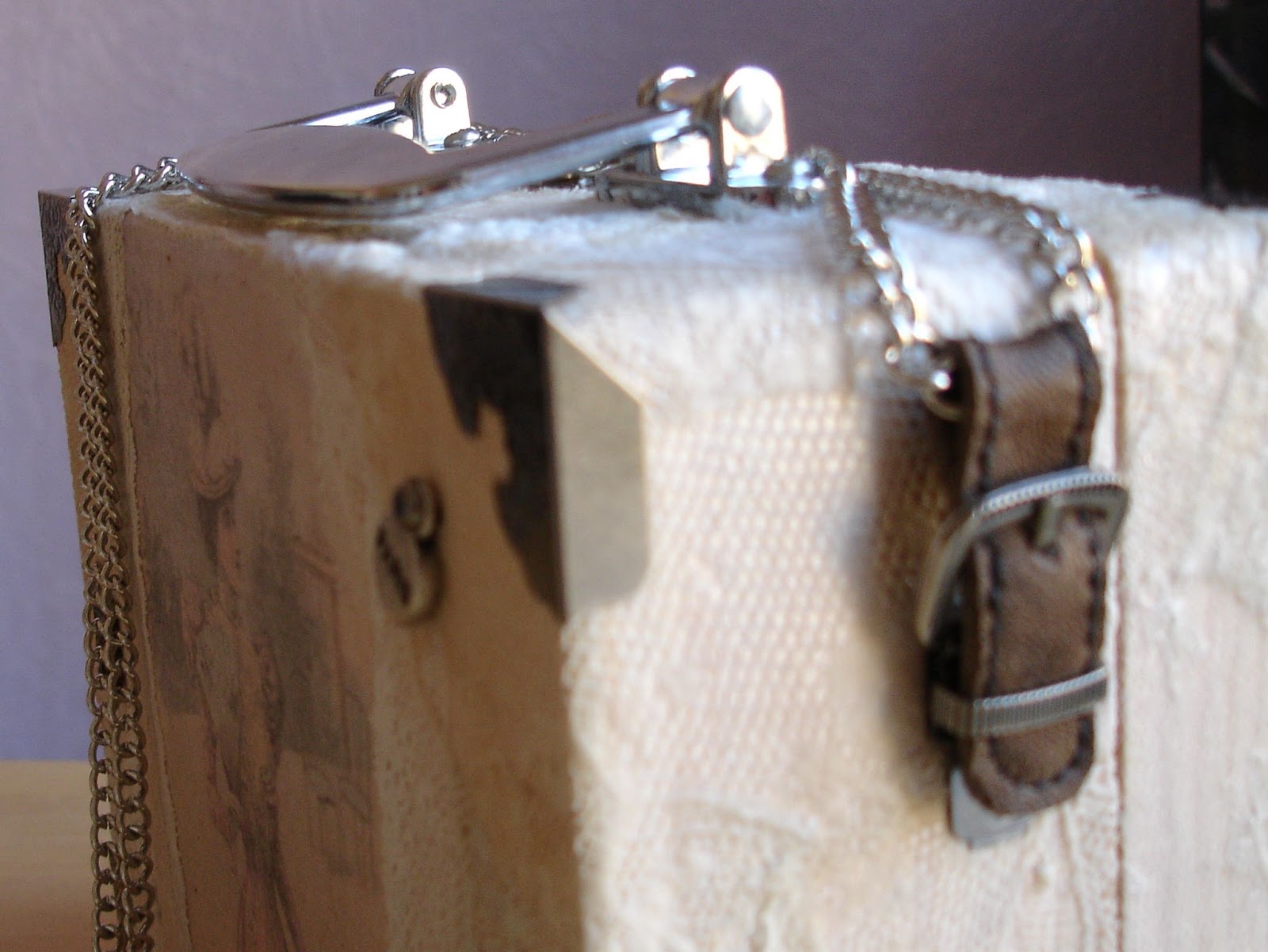
I found the box. Unlike others it already had with all of the hardware already attached. The hardware is silver in color and truth be told it was wonderful to have it already attached. One less thing to do to finish the project.

I have something called Paperpatch and while I was stateside I bought some Mod Podge. Using them for this project I noticed that the Mod Podge worked a bit better. It was less sticky faster, or better put it dried completely faster.


The original inspiration for this project was that lacquered box with the vintage ladies. To get my vintage ladies, I have an old book of La Mode Illustree from 1897 and have scanned some of the pictures.

I backed a piece of muslin with freezer paper and cut it to the size of a sheet of paper. using a color printer, the picture was reproduced.

I do not bother buying the ready made sheets at the stores since it is so easy to make them myself.

The result on muslin is a beautiful pastel look.

The drawing of the lady with a chair is called Toilette de Casino ou Garden Party is from 9 may 1897. It is one of my favorites since it reminds me of a park in Paris which has very sturdy chairs on gravel covered grounds surrounded by high walls and fountains. T

The park is popular with tourists and in beautiful weather, the chairs are in high demand. 

On the reverse side is a lady with an umbrella, also in a park like setting.  The issue is Sunday 18 April 1897.

According to the issue, This dress is called "Robe-princesse pour jeune femme". Just like the previous picture this dress once could have been purchased at Mmes Coussinet-Piret, rue Richer, 43 Paris. 

I Google Earthed rue Richer 43. It appears the building no longer exists. Where the building once stood is now it is a modern corner in Paris. C'est la vie! 

Enough research on the past, now to the project. 

To apply the pictures to the wood box, since I did not want a real stark wood background, I painted the box with a light layer of of white paint.  When dried, the wood of the box could still be seen, but it was greatly muted. 

Just the background look I wanted. 

I then Mod Podged the pictures to the box and began to layer the dry-rotted lace pieces over the box. 

When I found the look I liked, I Mod Podged the lace in place.


Here it is once all of the lace was in place:

To complete the outside and to protect the corners, metal corner pieces were glued in place. The box began to look "Paris" to me so a variety of Paris style trinkets were installed.

The hardware for the strap looks like a belt buckle so using some scrap leather, a shoulder strap was fashioned.

The inside of the box was lined. On the shorter depth side of the box, a pocket was sewn into the lining using elastic for the top of the pocket.  Here is is before it was glued into place:

A chain was added on both sides to keep the box from opening all of the way and a fabric guard was added so that when the box is open, the inside contents do not fall out.

Here is a picture of the completed front:

Here is the completed back.

I am going to let it cure for a couple of days before I wear it out, but I am pleased with the final result. Something new for me working with a wooden box and it was such a great use of dry rotted lace!

Tuesday, April 23, 2013

Rag Style bag

I have finished one of my UFO!

It's a bag I started a couple years ago using a common bag pattern that employs a pattern of patchwork squares. The backing, batting and top layer to each square are quilted together and then the quilted squares are sewn to each other with the seam allowances facing out. After the top was done, I had added a stabilizer and then a inside lining. I had sewn the bulk of the bag together and I stopped. I had used, and had sewn in an interfacing/stabilizer that I was very unhappy about the feel and look it added to the bag.

So it sat, and sat and sat, half finished in one of the drawers.
 
I am in a UFO challenge and this purse was one of the items I made sure I put on my list.

No wonder why I did not want to tackle it. Throwing it out might have been easier!
 
First it had to be taken apart and a different stabilizer had to be inserted. The bag then was sewn back together and the handles, strap and closure needed to be added. Since the bag is one of those rag style bags and I had already clipped it, let's just say, it was a messy job. Threads everywhere!

Finally once it was complete, it had to be washed so that the cut areas would "puff" to give that shaggy overall appearance.

I was able to know what to use inside of the bag due to having made the blue jean purse. The CraftsyDesign Your Own Handbag class has now been very handy on two projects.

Finally, here it is, complete at last.
 
I for one am glad it is done!

Sunday, April 14, 2013

Les coiffes catalanes

In France, in the Pyrénées Orientales, the region of France located south of Narbonne bordering Spain and Andorra, there was a traditional head gear, or cap, worn by women called a Catalan.
Click here for more information about this type of head gear.

This cap is trimmed with lace either, across the rim, or the bonnet piece in the back. As with all things lace, when the cap wore out or the owner no longer needed it, the lace was salvaged and stored away for future use. Not long ago, I came across a set of 6 of them. The woman who sold them to me told me that they were Calalan so, taking her word for it I will assume that is in fact what they are and where they are from.

All 6 are very different. After washing the patina of mold off of them, I removed the tie ribbons across the back that once held the cap tight to the head. After ironing, assessing damage and observing how they were made, due to a challenge at my local patchwork club, I decided to use them to make my challenge entry. More about that later. First let's look at the Catalan's pieces.

The first one is really nothing new. It is as a matter of fact quite common for it's era. It is made of wide machine manufactured cotton edging. It was hand sewn together so that the curvy part of the edging shows as it was sewn to the next piece. Finding edging used in this manner is common. I have a theory, or rather an observation as to why edging was used and not insertion. I have noticed at flea markets that edging is more widely available and a lot of it was unused. In garment or household item construction, The interior of the item is where the insertion would have been used. Normally there is much more of the insertion used for those inside design areas then there was needed for the edge areas. In the age of small shops and not many choices, if edging was all that was available, edging is what was going to be used. 

Looking at it from another angle, if a shop bought stock of equal number of meters of insertion and edging, there would be more edging available at the shop because the insertion would sell out first. More is used most of the time. Even in modern stores I have noticed that there is a wider variety of edging than insertion. Edging has more uses. 

Observation based on what I have found at flea markets is that in the recuperation process, many times more in the interior of the item is damaged. Yes the edging may be damaged, but more often it appears to be the insertion not the edging that is worn. It is also harder to recuperate the insertion but it is easy to recuperate the edgings. 

Here is a picture of the machine edging Catalan cap bonnet piece:

The rest of the pieces are more interesting and are absolutely beautiful. They are constructed by hand and some of the laces are done by hand as well.

The second piece is the smallest of the group. It consists of a purchased cotton insertion and an insertion which has hand embroidered flowers and vines on what appears to be finella. Finella is thinner than batiste almost like a fine silk in it's see though quality.

The third piece, similar in construction is also made from a machine lace insertion and a hand embroidered insertion also on a fine fabric like finella.
 
 
The next piece, the forth piece, is very interesting. It appears to be embroidered netting. Looking closely it is actually embroideries that were appliquéd to the netting.


 Here is a close-up of the back. You can see the stitches out of a rather heavy thread holding both the  design and the "insertion". This is all one piece of netting with the appliqué laid on top.
The last piece, the fifth one, is the same construction technique as the fourth piece only it is constructed on finella.

Here is a close-up of the back. You can see the stitches again out of a rather heavy thread. This is all one piece of finella with the appliqué embroidered pieces laid on top.

I have seen this before where the embroideries are done first and them are appliquéd onto a fine fabric. Here is a corner of a small doilie. 

Now look at the back of the item:

 Notice how it is appliqued in place and the inside of the leaves are added now keeping the leaves to the background fabric.  This same technique was used on the coiffes.

One last picture, from the top you can see where some of the grapes are beginning to come loose.
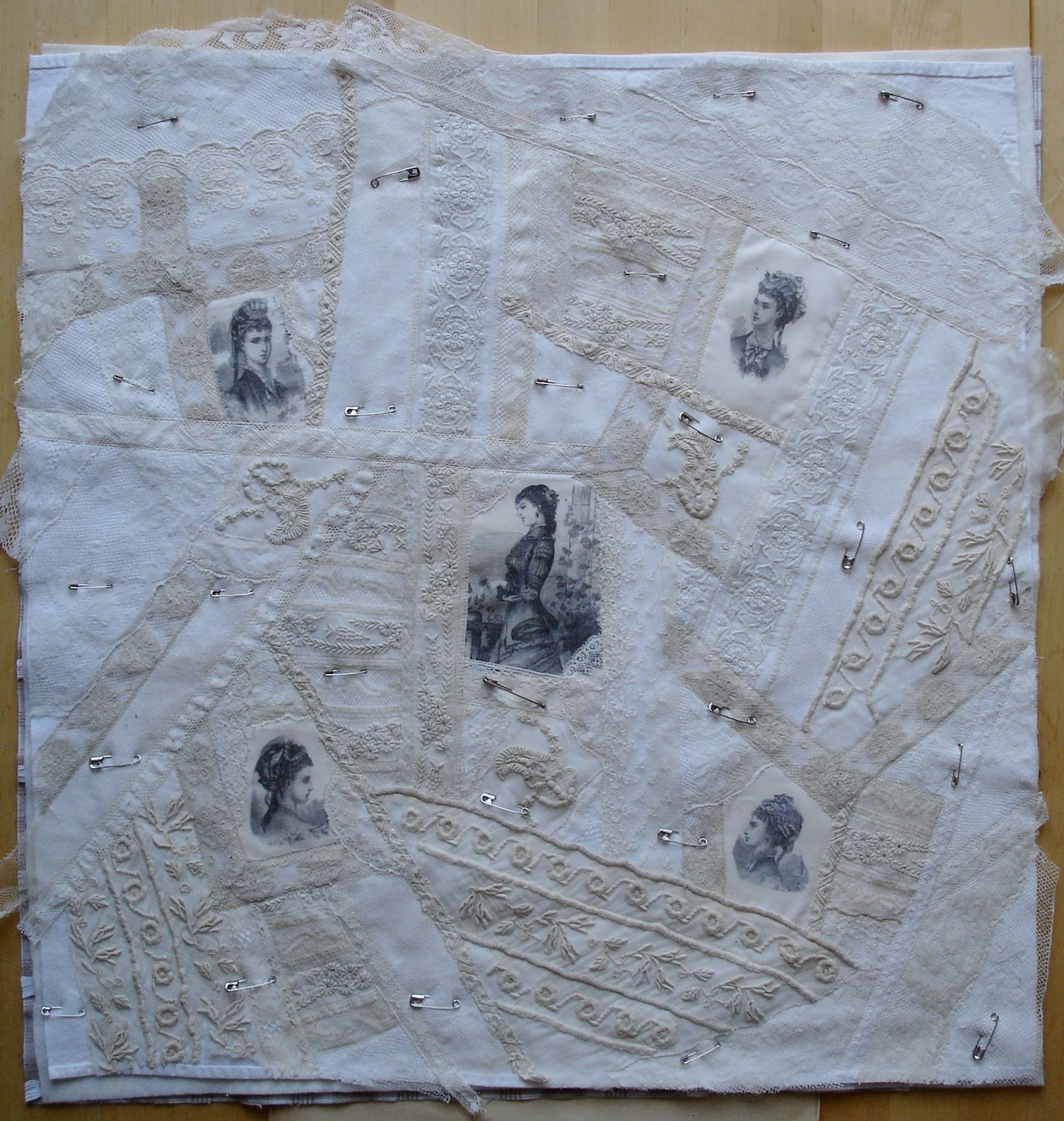
Now back to my project, for my challenge I needed a 50cm (20 inch) square finished block using only one color. So if I had chosen blue, I could use as many shades of blue I wanted. Being the queen of vintage lace, I desired to chose white. That would mean I could go from bright white all the way through shades of off white or ecru. For the support  behind my lace masterpiece I chose a vintage piece of cotton I salvaged off of a table runner. I envisioned some a sort of crazy patch of lace. The last part of the challenge is that we need to accessorize the block in some way. For me that would mean using vintage buttons, textured ribbon and trinkets.

First I painstakingly disassembled all of the coiffes. Interestingly I found that in several of the pieces that the mechanical lace was dry rotted. The handmade lace pieces were fine. I ended up with a pile of dry rot. 

I set it aside. I am so excited! I now have something to use with paint for another project I have been collecting pieces for! I bet you have never seen anyone so happy to find dry rot.

Then came digging through the stash for some pieces of lace that would make interesting additions. I had to find some buttons and beads.


Then came digging through the stash for some pieces of lace that would make interesting additions.

I started to lay things out and then I saw a blog by Lilla Le Vine. From there I found that she has a number of youtubes you can watch so I began to watch them while I was sewing. She in interesting. She is a Francophone living in Hawaii, here I am a non-francophone living in France. Odd world we live in.
 
I recently came across a couple of "La Mode Illustree" magazines from the late 1800s.
 

  Inside the magazine was a wealth of information, all clearly written in French, as well as fashion drawings on how to wear the latest fashion. If you are lucky you can get the pattern that was included with the magazine to attempt to reproduce an outfit in the magazine. I took Lilla's method of transferring designs to make copies on paper of some of the pictures I really liked from the magazine. She uses Mod Podge. I looked for it on line, it is available in France only I could not find it. While in Lyon a couple of weeks back I bought something called "Paperpatch". They make one for fabrics. I bought the brush that was recommended as well. It appears to be the same thing.
I started laying out the pictures and the lace to figure out what I wanted to do.
 
This was one of the projects that I knew what it would look like before I started.
I started in one corner
 
and worked to the center
and then down, hold your breath while you cut up one of the pieces. 
 
and around to the other side.


The top is now complete, it has a backing, a stabilizer, batting and the top. It is now ready for additions of button and beads.

I decided to put it all together first before I embellished it since I want to use some of the additions, like the buttons as a sort of quilting to hold it all together. I will also be doing a little machine quilting to the top as well.

Expect to see the finished product in the next couple of months. It has to be completed by September.